
Vembur Sheep: A Complete Guide to Tamil Nadu’s Rare Indigenous Sheep Breed
Meta Description: Discover everything about the Vembur sheep — India’s rare indigenous hair sheep breed from Tamil Nadu. Learn about its origin, physical traits, economic value, breeding, and conservation status.
Focus Keyword: Vembur sheep
Introduction
The Vembur sheep is one of India’s most distinctive and lesser-known indigenous livestock breeds. Native to the semi-arid tracts of southern Tamil Nadu, this hardy hair sheep has quietly sustained generations of small and marginal farmers while playing a central role in the region’s agrarian economy and cultural identity. Known locally as “Pottu Aadu” — a name inspired by the breed’s striking spotted coat — the Vembur sheep is instantly recognizable for its white body dotted with reddish-brown or fawn patches.
Despite its economic and ecological importance, the Vembur sheep remains relatively unknown outside agricultural and conservation circles. In recent years, growing concern over industrial expansion into traditional grazing lands has brought renewed attention to this breed. This article offers an in-depth look at the Vembur sheep — its origin, physical characteristics, behavior, economic significance, breeding patterns, health traits, and the conservation challenges it faces today.
Whether you are a livestock farmer, an animal husbandry student, a researcher, or simply someone curious about India’s indigenous animal breeds, this comprehensive guide will help you understand why the Vembur sheep deserves far greater recognition and protection.
What Is the Vembur Sheep?
The Vembur sheep is a native meat-type (mutton) sheep breed that has evolved over centuries in the hot, dry, semi-arid climate of southern Tamil Nadu. It belongs to the broader category of South Indian hair sheep breeds, meaning it grows hair instead of wool and therefore does not require shearing — a trait that makes it particularly low-maintenance compared to wool-producing sheep breeds found in northern and temperate regions of India.
The breed derives its name from Vembur, a village in the Thoothukudi (Tuticorin) district of Tamil Nadu, believed to be its place of origin. Over generations, the breed spread to neighboring areas while retaining its core physical and adaptive traits.
Tamil Nadu is home to eight officially recognized sheep breeds, broadly divided into wool types (Coimbatore, Nilgiri, and Tiruchi Black) and meat types (Kilakarsal, Madras Red, Mecheri, Ramnad White, and Vembur). Among these, the Vembur sheep is prized specifically for its meat quality, disease resistance, and ability to thrive on minimal resources — qualities that have earned it the affectionate title of the “poor man’s cow” in rural Tamil Nadu, much like how cattle are regarded as a lifeline for subsistence farmers elsewhere in India.
Origin and Geographic Distribution
The Vembur sheep is primarily concentrated in and around the Thoothukudi and Virudhunagar districts of Tamil Nadu, with smaller populations extending into parts of Tirunelveli district. This region is characterized by a semi-arid climate, scrubland vegetation, and native grasses — conditions that have shaped the breed’s hardiness and resilience over time.
Historically, the breed has been closely tied to Tamil rural culture, with local communities rearing Vembur sheep not merely as livestock but as a form of generational wealth and social security. Families have depended on the sale of Vembur sheep to fund essential needs such as children’s education, medical expenses, and household emergencies.
According to a 1998 survey, the Vembur sheep population was estimated at around 31,000 animals, with an average flock size of approximately 38 to 39 animals per herd, typically comprising one ram, roughly 24 to 25 ewes, and around 13 lambs. A later national assessment — the 18th Livestock Census conducted in 2007 — recorded a notably higher figure of over 235,000 Vembur sheep across the country, reflecting either a broader survey scope or a genuine expansion in numbers during that period. Despite this, the breed’s distribution remains narrow and geographically restricted, which is one of the key reasons conservationists classify it as a breed requiring close monitoring.
Physical Characteristics of the Vembur Sheep
One of the most defining features of the Vembur sheep is its appearance. Understanding its physical traits is essential for identifying purebred animals and distinguishing them from crossbred or other native sheep varieties.
Body Structure and Size
Vembur sheep are medium to tall in stature with a lean, athletic body frame. Research on the breed has recorded average body measurements in adult males of roughly 76 cm in body length, about 82 cm in height at the withers, and close to 88 cm in chest girth. Adult females are comparatively smaller, with body length around 67 cm, height at withers near 75 cm, and chest girth close to 78 cm. In terms of body weight, adult rams typically weigh around 43 kg, while ewes average closer to 30 kg.
Lambs also show a fairly steady growth pattern, with average body weights of roughly 12 kg at three months, increasing to about 16 kg at six months, 19 kg at nine months, and around 22 kg by twelve months of age.
Coat Color and Pattern
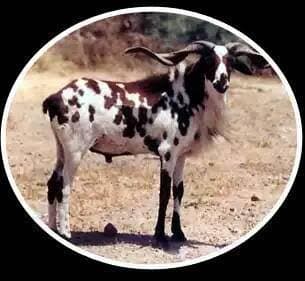
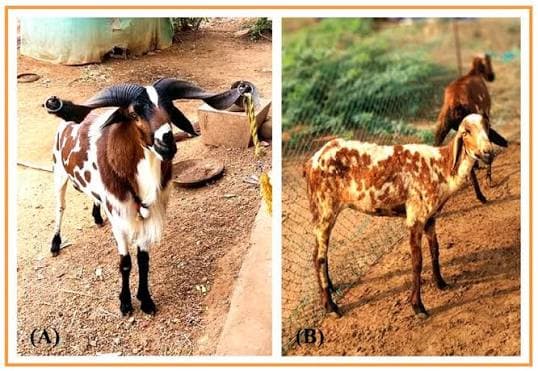
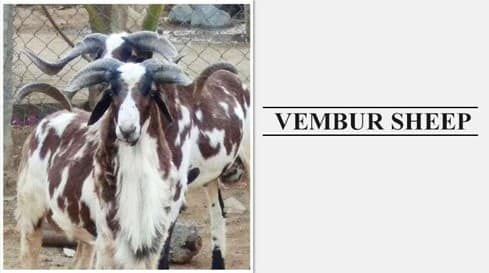
The Vembur sheep’s most distinguishing visual trait is its coat: a predominantly white body marked with irregular reddish-brown, fawn, or black patches and spots. This spotted pattern is so iconic that it inspired the breed’s nickname, “Pottu Aadu,” where “pottu” refers to a dot or spot — much like the traditional bindi worn on the forehead. No two Vembur sheep have an identical spot pattern, making each animal visually unique.
Coat Type
Unlike wool sheep breeds, Vembur sheep have a short, coarse, and hairy coat rather than a woolly fleece. Because they are classified as hair sheep, they shed naturally and do not require shearing, which significantly reduces the labor and cost associated with their upkeep compared to wool breeds.
Ears, Horns, and Other Features
The Vembur sheep has medium-sized, semi-pendulous (drooping) ears, which is one of its more recognizable facial features. Rams typically possess large, thick, twisted, and heavily corrugated horns that curve outward, usually black in color, while the majority of ewes are naturally polled (hornless), though a small percentage may develop rudimentary horns.
Males generally lack wattles, while a small proportion of females may have small wattles present near the neck. The neck is short and thick in rams, while it is shorter and more slender in ewes. The legs are long, lean, and bony, though the thighs are not heavily muscled, and the hooves are black. The tail is short, small, and tapers toward the end. The udder in ewes is compact, with small teats that point slightly outward.
Behavior and Adaptability
Vembur sheep are well known for their remarkable adaptability to harsh, arid environments. Bred over centuries in a hot and dry climate with limited water and unpredictable rainfall, the breed has developed strong heat tolerance and an ability to thrive on sparse, native vegetation without depending on commercial or supplementary feed.
This grazing efficiency is one of the breed’s greatest economic advantages. Vembur sheep are typically raised under extensive or semi-extensive grazing systems, where flocks are taken out to graze on communal lands, fallow fields, scrublands, and roadside vegetation during the day and returned to enclosures at night. This traditional management system requires minimal capital investment, making sheep rearing accessible even to landless laborers and marginal farmers who cannot afford intensive livestock systems.
The breed is also known for being hardy against many common livestock ailments prevalent in the region, in part due to natural selection over generations in a challenging environment. Interestingly, scientific studies have examined the interdigital glands of Vembur sheep — glands located between the hooves — finding that they contain sebaceous and apocrine secretory structures that are more developed in males than females. These glands are believed to play a role in chemical communication between animals and may also help protect the sheep from foot-related infections, a valuable trait for animals that spend most of their day walking and grazing on rough terrain.
Economic and Cultural Importance
The Vembur sheep occupies a central place in the rural economy of southern Tamil Nadu. For generations, families in the Thoothukudi and Virudhunagar districts have depended on these animals not just for meat, but as a reliable source of income and a form of savings that can be liquidated during emergencies.
Livelihood Support
Because Vembur sheep require little more than access to open grazing land, they represent one of the most cost-effective livestock options available to small and marginal farmers. Flocks can be built up gradually and sold in stages to meet financial needs, whether that means funding a child’s school fees, covering medical costs, or managing a household crisis. This function as a “living bank account” is a major reason the breed has been so deeply woven into the region’s socio-economic fabric.
Market Value
Over recent years, demand for Vembur sheep has grown due to the quality of its meat, and market prices have risen accordingly. A breeding pair of Vembur sheep can fetch anywhere between roughly ₹18,000 and ₹20,000, a meaningful sum for rural households that depend on livestock rearing as a primary or supplementary income source.
Cultural Identity
Beyond its economic role, the Vembur sheep is a symbol of regional identity and heritage in Tamil Nadu. The breed’s presence in local folklore, its association with traditional farming practices, and its long-standing role in community life make it more than just livestock — it represents a living connection to generations of pastoral tradition in the region.
The “Poor Man’s Cow”
Much as cattle serve as an economic lifeline in many parts of rural India, sheep like the Vembur breed have earned the moniker “poor man’s cow” because they provide meat, hide, and a modest but steady income to farmers who may not have the resources to invest in more capital-intensive livestock or crops. This makes the breed especially important in semi-arid zones where crop farming and dairy operations are often not economically viable.
Breeding and Reproduction
Breeding practices for Vembur sheep have traditionally been informal and community-based, relying on selection within existing flocks rather than structured breeding programs. Farmers generally choose breeding rams and ewes based on visible traits such as body size, coat pattern, and overall vigor, passing down informal selection knowledge through generations.
Reproductive Traits
The Vembur sheep has a relatively slow reproductive cycle compared to some other livestock breeds. Ewes typically give birth to a single lamb per pregnancy, with twin births being uncommon. In farmer-managed flocks, the lambing percentage has been recorded at around 80 percent, and litter size is generally just one lamb per cycle. This single-lamb tendency, while contributing to the breed’s overall hardiness and manageable flock sizes, also means that population growth remains gradual, which has implications for conservation planning.
Genetic Diversity
Scientific studies using microsatellite DNA markers have been conducted to assess the genetic diversity of Vembur sheep populations. One such study identified a substantial number of genetic alleles across the sampled population, indicating a reasonably diverse gene pool within the breed at the time of study, though continued monitoring is important to ensure this diversity is preserved as the breed’s habitat shrinks.
Health, Disease Resistance, and Management
One of the reasons Vembur sheep remain popular among traditional farmers is their comparatively strong resistance to disease and their ability to thrive without significant veterinary intervention. This resilience is largely a product of natural selection: over generations, only animals well-suited to the local climate, forage conditions, and disease pressures have survived and reproduced, gradually strengthening the breed’s overall hardiness.
Low Input Requirements
Because Vembur sheep are raised primarily on natural grazing rather than commercial feed, farmers incur minimal costs for feeding. This extensive grazing system also reduces the risk of certain digestive and metabolic disorders that can affect intensively fed livestock.
Foot Health
Research into the interdigital glands of Vembur sheep suggests these structures may play a protective role against foot-borne diseases, which are a common concern for grazing animals that spend long hours walking on rough, dry terrain. This natural adaptation likely contributes to the breed’s overall foot health and mobility.
General Care Practices
Traditional Vembur sheep husbandry typically involves:
- Daytime grazing on communal lands, scrublands, and fallow agricultural fields
- Return to simple enclosures or pens at night for protection from predators and theft
- Minimal supplementary feeding, reserved mostly for lactating ewes or during periods of drought
- Community-based breeding and flock management passed down through generations
- Periodic veterinary check-ups, particularly for vaccination against common ovine diseases
Conservation Status and Emerging Threats
While the Vembur sheep population has remained relatively stable over the past two decades, the breed now faces a growing and urgent threat: the loss of grazing land to industrial development.
The SIPCOT Land Issue
A significant concern for the Vembur sheep’s future is a proposed State Industries Promotion Corporation of Tamil Nadu (SIPCOT) industrial project that plans to acquire a substantial stretch of land — estimated at around 1,000 acres — in the breed’s core grazing territory. Since Vembur sheep depend almost entirely on access to open grazing land for their extensive, low-cost rearing system, the loss of this land poses a direct threat to the livelihoods of the farmers who raise them.
Local farmers have expressed concern that without sufficient grazing area, many families may be forced to reduce their flocks or abandon sheep rearing altogether, since the extensive grazing model that makes Vembur sheep economically viable cannot easily be replicated through intensive, feed-based systems without significantly raising costs.
Slow Population Recovery
Compounding this land pressure is the breed’s naturally slow reproductive rate. Since ewes typically produce only a single lamb per breeding cycle, the population cannot recover quickly from any sudden decline caused by habitat loss, disease outbreaks, or reduced farmer interest. This makes proactive conservation planning especially important for the Vembur sheep compared to breeds with higher reproductive rates.
Declining Interest Among Younger Generations
Another challenge facing the breed is a generational shift away from traditional livestock farming. As younger members of farming families increasingly pursue urban employment or non-agricultural careers, fewer people are taking up sheep rearing, putting additional pressure on the long-term sustainability of Vembur sheep flocks.
Why Conservation Matters
The disappearance of the Vembur sheep would represent more than the loss of a single animal breed — it would mean the erosion of a centuries-old agricultural tradition, a loss of genetic diversity within India’s indigenous livestock resources, and the collapse of a livelihood system that has supported generations of rural families in Tamil Nadu. Conservationists argue that protecting grazing lands, supporting breeder cooperatives, and raising awareness about the breed’s unique value are essential steps to secure its future.
Vembur Sheep vs. Other Tamil Nadu Sheep Breeds
Tamil Nadu’s eight recognized sheep breeds are broadly split between wool types and meat types. The Vembur sheep belongs to the meat-type category, alongside Kilakarsal, Madras Red, Mecheri, and Ramnad White. Compared to these other meat breeds, the Vembur sheep is particularly noted for its distinctive spotted coat pattern, which sets it apart visually from breeds like the more uniformly colored Mecheri or the reddish-toned Madras Red.
While detailed comparative performance data varies by study, the shared traits among these southern breeds — hair coats, adaptation to semi-arid conditions, and reliance on extensive grazing — reflect the broader evolutionary pressures shaping sheep breeding across Tamil Nadu’s dry agroclimatic zones.
Frequently Asked Questions About Vembur Sheep
1. What is a Vembur sheep known for?
The Vembur sheep is known for its distinctive white coat with reddish-brown or fawn spots, its hair coat that requires no shearing, and its adaptability to hot, semi-arid climates. It is a meat-type breed native to Tamil Nadu.
2. Where are Vembur sheep found?
Vembur sheep are primarily found in the Thoothukudi and Virudhunagar districts of Tamil Nadu, India, with smaller populations in parts of Tirunelveli district.
3. Why is the Vembur sheep called “Pottu Aadu”?
The name “Pottu Aadu” comes from the Tamil word “pottu,” meaning spot or dot, referring to the breed’s characteristic spotted coat pattern.
4. Do Vembur sheep need to be sheared?
No. Vembur sheep are hair sheep, not wool sheep, so they naturally shed their coat and do not require shearing.
5. How much does a Vembur sheep cost?
Market prices vary, but a breeding pair of Vembur sheep has recently sold for approximately ₹18,000 to ₹20,000.
6. What threats does the Vembur sheep face today?
The breed’s biggest current threat is the loss of grazing land due to industrial expansion projects, combined with its naturally slow reproductive rate and declining interest among younger farmers.
7. How many lambs does a Vembur ewe typically produce?
Vembur ewes generally give birth to a single lamb per breeding cycle, with a lambing percentage of around 80 percent in farmer-managed flocks.
Conclusion
The Vembur sheep stands as a remarkable example of how indigenous livestock breeds can embody centuries of adaptation, cultural heritage, and economic resilience. From its striking spotted coat to its low-maintenance grazing habits and disease resistance, this Tamil Nadu native has proven itself to be far more than an ordinary farm animal — it is a cornerstone of rural livelihoods and a symbol of regional identity.
Yet, as industrial development encroaches on its traditional grazing lands and younger generations move away from pastoral life, the Vembur sheep’s future is far from guaranteed. Protecting this breed will require coordinated efforts from farmers, policymakers, and conservationists alike — from safeguarding grazing commons to promoting awareness of the breed’s unique genetic and cultural value.
For anyone interested in India’s rich diversity of indigenous animal breeds, the Vembur sheep offers a compelling case study in sustainable, low-input livestock farming — and a reminder of how much can be lost when traditional agricultural systems are not protected alongside the communities and animals that depend on them.
just now