
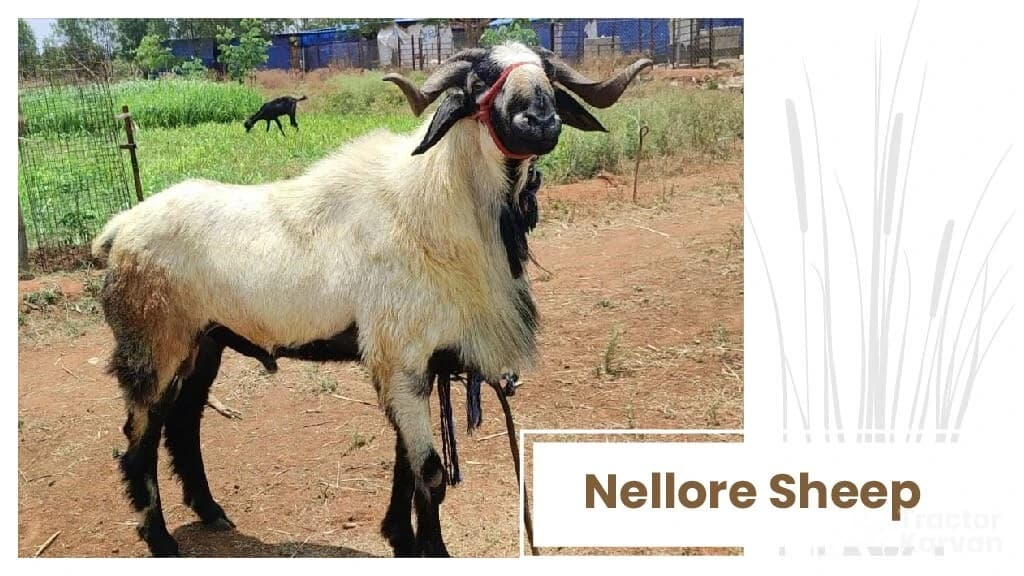
Nellore Sheep Indian Breed: Complete Farming, Characteristics, and Commercial Guide
The Nellore sheep stands as the tallest, most robust, and commercially lucrative indian breed of sheep dedicated primarily to mutton production. Originating from the semi-arid regions of Andhra Pradesh and Telangana, this indigenous livestock asset has earned a formidable reputation among farmers, commercial breeders, and agricultural entrepreneurs across South India. Known for its tall body structure, extraordinary adaptability to harsh tropical climates, disease resistance, and rapid weight gain, the Nellore sheep is a cornerstone of rural livestock economies.
This guide provides a comprehensive breakdown of the Nellore sheep indian breed, covering its physical traits, sub-types, nutritional demands, health management, breeding strategies, and commercial farming potential.
Overview and Classification of Nellore Sheep
Classified as a hair-type hair/mutton sheep, the Nellore sheep indian breed does not produce commercial-quality wool. Instead, its body is covered with short, coarse hair, making it uniquely suited to hot, dry tropical environments where wool-producing sheep struggle to survive.
Breed Profile Summary
| Parameter | Specification |
| Breed Name | Nellore Sheep |
| Category | Mutton Type (indian breed) |
| Primary Origin | Nellore, Prakasam, and Chittoor districts (Andhra Pradesh) |
| Tail Type | Short and thin |
| Fleece Type | Coarse hair (no commercial wool) |
| Average Adult Ram Weight | 45 kg – 55 kg (Can reach 65+ kg with stall-feeding) |
| Average Adult Ewe Weight | 30 kg – 40 kg |
| Twining Rate | Low (Mostly single births, ~2-5% twins) |
| Dressing Percentage | 48% – 52% |
Origin and Geographical Distribution
The Nellore sheep indian breed derives its name from the district of Nellore in Andhra Pradesh. Over centuries, natural selection and selective breeding by local pastoral communities have perfected this breed for tropical survival.
- Core Native Region: Nellore, Prakasam, Guntur, Kurnool, and Chittoor districts of Andhra Pradesh.
- Extended Adaptation Zone: Telangana, Tamil Nadu, Karnataka, and Maharashtra.
- Climatic Tolerance: Thrives in hot, dry climates where temperatures frequently exceed 40°C. It is capable of trekking long distances in search of pasture with minimal water requirements.
Varieties of the Nellore Sheep Indian Breed
The Nellore sheep indian breed is divided into three distinct sub-types or varieties based primarily on coat color and facial patterns:
                          Nellore Sheep
                                |
        +-----------------------+-----------------------+
        |                       |                       |
  Nellore Palla           Nellore Jodipi          Nellore Dora
 (Pure White Coat)     (White with Black Spotting) (Pure Brown Coat)
1. Nellore Palla
- Appearance: Completely white coat across the entire body, head, and legs.
- Distinct Traits: Sleek appearance, highly preferred in religious rituals and specific festive markets.
- Growth: Offers excellent body length and frame size.
2. Nellore Jodipi
- Appearance: White body with characteristic black patches around the eyes, muzzle, ears, and feet.
- Popularity: Most widely reared variety among commercial farmers due to high market demand and fast growth rates.
- Market Advantage: Highly recognized in livestock markets across Andhra Pradesh, Telangana, and Karnataka.
3. Nellore Dora
- Appearance: Uniform reddish-brown to dark tan coat across the body.
- Distinct Traits: Extremely hardy, robust leg structure, and highly preferred for extensive grazing in dry bushlands.
Key Physical Characteristics and Identification Features
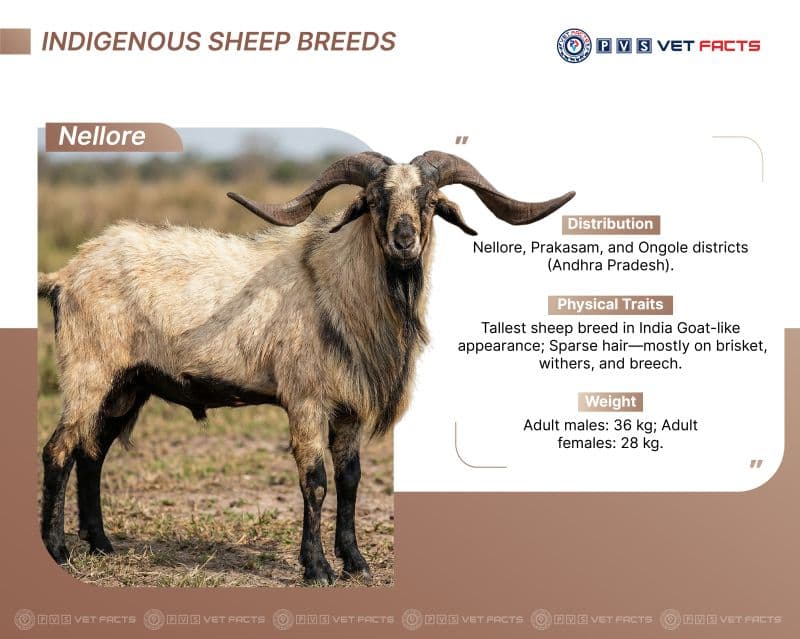
Recognizing a purebred Nellore sheep indian breed requires identifying several distinct physical characteristics:
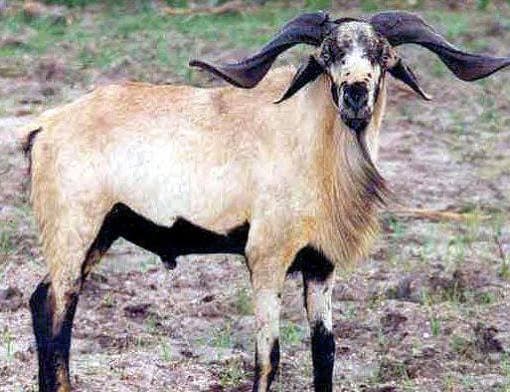
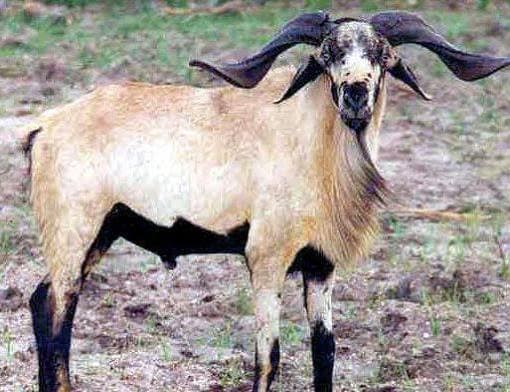
- Body Frame & Height: It is the tallest indian breed of sheep. Rams stand approximately 75–85 cm high at the withers, while ewes average 70–75 cm.
- Head & Ears: Long, narrow head with a convex facial line (Roman nose). Ears are long, broad, and pendulous (drooping downward).
- Horns:
- Rams: Typically horned with strong, twisted backward and downward horns.
- Ewes: Polled (hornless).
- Neck and Body: Long neck, deep chest, well-developed brisket, and a long straight back line. Leg bones are long and strong.
- Dewlap: A well-marked fold of skin (dewlap) runs from the throat down to the brisket in rams.
- Tail: Short, thin, and tapering, ending above the hock joint.
Economic Advantages of Nellore Sheep Farming
Investing in this specific indian breed offers distinct financial and operational advantages for smallholders and large commercial setup operators alike:
High Meat-to-Bone Ratio
The dressing percentage (carcass yield) ranges between 48% and 52%. The meat is lean, tender, and carries high consumer preference in South Indian livestock markets, commanding premium prices per kilogram of live weight.
Low Maintenance & Extreme Hardiness
Unlike delicate imported breeds, the Nellore sheep indian breed possesses strong natural immunity against common endemic tropical diseases, including foot rot and internal parasite infestations.
High Feed Conversion Efficiency (FCR)
When transitioned from traditional grazing to semi-intensive or intensive stall-feeding systems (Total Mixed Ratio / TMR), Nellore rams demonstrate daily weight gains of 100 to 150 grams.
Excellent Walking Ability
For pastoralists following nomadic or semi-nomadic grazing, the long-legged structure of this indian breed enables it to cover 10–15 kilometers daily without physical exhaustion.
Reproductive and Breeding Management
To maximize profit in a sheep farming venture centered on this indian breed, careful reproductive management is essential.
Breeding Cycle Timeline:
[Estrus / Heat Cycle: Every 17 Days] -> [Gestation Period: 147–152 Days] -> [Lambing] -> [Suckling: 90 Days] -> [Re-breeding]
Key Reproductive Metrics
- Age at First Heat (Puberty): 12 to 15 months (can be reduced to 10–12 months with intensive nutrition).
- Age at First Lambing: 18 to 20 months.
- Gestation Period: 147 to 152 days (~5 months).
- Lambing Interval: 8 to 9 months under proper management, allowing 3 lambings in 2 years.
- Lambing Rate: 85% to 92% under sound management.
- Twinning Percentage: Low (2% to 5%). Focus is on single, high-birthweight lambs (2.5 – 3.2 kg at birth).
Selecting Breeding Stock
- Selecting Rams: Choose rams that are 1.5 to 2 years old, displaying strong masculinity, broad chest, straight long back, deep body frame, and well-developed testicles. One active ram is sufficient for 25 to 30 ewes.
- Selecting Ewes: Select broad-hipped, healthy ewes with well-formed udders and two functional teats. Avoid ewes with history of difficult lambing or poor mothering instincts.
Feeding and Nutritional Strategy
A balanced diet is critical to unlock the growth potential of the Nellore sheep indian breed. Sheep are ruminants that thrive on a combination of roughage (green and dry fodder) and concentrate feed.
Daily Feed Requirements by Age Group
| Life Stage | Green Fodder (Kg/day) | Dry Fodder (Kg/day) | Concentrate Feed (Grams/day) |
| Lambs (3-6 Months) | 1.0 – 1.5 | 0.2 – 0.3 | 150 – 200 |
| Adult Ewes (Maintenance) | 3.0 – 4.0 | 0.5 – 0.8 | 150 – 200 |
| Pregnant Ewes (Late Term) | 4.0 – 5.0 | 0.8 – 1.0 | 300 – 350 |
| Lactating Ewes | 5.0 – 6.0 | 1.0 | 400 – 500 |
| Breeding Rams / Fattening | 5.0 – 6.0 | 1.0 – 1.2 | 400 – 600 |
Recommended Concentrate Feed Formula
To formulate 100 kg of high-quality concentrate feed for the Nellore indian breed:
- Maize/Corn (Crushed): 40 kg
- Groundnut Cake or Soybean Meal: 20 kg
- Rice Bran or Wheat Bran: 27 kg
- Molasses: 10 kg
- Mineral Mixture: 2 kg
- Common Salt: 1 kg
Housing and Shed Management
Proper housing protects the Nellore sheep indian breed from extreme rains, cold winds, predators, and disease-causing pathogens.
Elevated Slatted Flooring Layout:
+-------------------------------------------------------+
|                 Shed Roof (GI / Thatch)               |
|                                                       |
|   [Ewes Pen]     [Lambing Creep]     [Fattening Rams] |
| ===================================================== | <-- Wooden / Plastic Slatted Floor (1.5m high)
|                                                       |
|                   Dung & Urine Pit                    |
+-------------------------------------------------------+
Housing Design Specifications
- Floor Space Requirements:
- Adult Ewe: 10 – 12 sq. ft. covered space + 20 sq. ft. open yard.
- Breeding Ram: 15 – 20 sq. ft. covered space + 30 sq. ft. open yard.
- Lambs: 5 – 6 sq. ft. covered space.
- Flooring Type: Elevated slatted flooring (wooden or heavy-duty plastic slats 3 to 5 feet above ground) is strongly recommended. This lets urine and dung drop through, keeping the sheep dry and reducing internal parasite risks.
- Ventilation: Maintain a roof height of 10–12 feet with open side mesh to allow continuous airflow.
Health Care, Vaccination, and Deworming Schedule
Despite the natural hardiness of this indian breed, a preventive healthcare schedule ensures zero mortality and consistent weight gain.
Essential Vaccination Schedule
| Disease | Age at First Dose | Booster Dose | Frequency |
| Peste des Petits Ruminants (PPR) | 3 Months | Not required (Lifelong) | Once in a lifetime |
| Enterotoxaemia (ET) | 2 Months | 15 days after 1st dose | Annually (Before Monsoon) |
| Foot and Mouth Disease (FMD) | 4 Months | 1 Month later | Bi-annually (Every 6 Months) |
| Anthrax | 6 Months | — | Annually (Endemic areas) |
| Sheep Pox | 3-4 Months | — | Annually (December/January) |
Deworming Protocol
- Deworming Frequency: 3 to 4 times a year (Pre-monsoon, Post-monsoon, Winter, and Summer).
- Rotational Drugs: Alternate between Albendazole, Fenbendazole, Levamisole, and Ivermectin to prevent parasite resistance.
Comparison: Nellore vs. Other Popular Indian Sheep Breeds
To understand why the Nellore sheep indian breed dominates southern commercial markets, it helps to compare it with other prominent native sheep breeds of India.
| Feature | Nellore Breed | Bannur / Mandya | Deccani | Eluru / Mecheri |
| Origin State | Andhra Pradesh | Karnataka | Telangana / MH | Tamil Nadu |
| Primary Purpose | Meat / Mutton | Meat / Mutton | Wool & Meat | Meat |
| Body Size / Height | Tallest | Compact / Small | Medium | Medium |
| Adult Ram Weight | 45 – 55+ kg | 30 – 35 kg | 35 – 40 kg | 35 – 40 kg |
| Coat Type | Short Hair | Coarse Hair | Coarse Wool | Short Hair |
| Growth Speed | Very Fast | Moderate | Moderate | Moderate |
Commercial Economics: 100 Ewes + 4 Rams Unit (Sample Estimate)
Setting up a commercial breeding farm with the Nellore sheep indian breed offers high returns on investment (ROI) over a 3-year horizon.
Initial Capital Expenditure (CapEx)
- Cost of 100 Ewes (8-10 months old @ ₹7,000 each): ₹7,000,000
- Cost of 4 Breeding Rams (@ ₹12,000 each): ₹48,000
- Shed Construction (1,500 sq. ft. slatted floor): ₹3,50,000
- Equipment (Feeders, Drinkers, Chaff Cutter): ₹50,000
- Initial Fodder Cultivation & Misc Expenses: ₹52,000
- Total Initial Investment: ~₹12,00,000
Recurring Operating Expenses (OpEx – Annual)
- Feed & Concentrate Cost: ₹2,50,000
- Healthcare & Vaccinations: ₹30,000
- Labor Costs: ₹1,80,000
- Electricity, Water, & Misc: ₹40,000
- Total Annual Operating Cost: ~₹5,00,000
Expected Revenue (Year 2 Onward)
- Lamb Yield: ~130 lambs per year (assuming 85-90% lambing rate with 1.3 cycles/year).
- Sale of Male & Female Lambs (at 8-9 months, ~30-35 kg live weight @ ₹400/kg): 130 × ₹12,000 = ₹15,60,000
- Sale of Sheep Manure & Waste: ₹40,000
- Gross Annual Income: ₹16,00,000
- Net Profit (Gross Income – OpEx): ~₹11,00,000 / year
Frequently Asked Questions
Is Nellore sheep suitable for stall-feeding (intensive) farming?
Yes. The Nellore sheep indian breed performs exceptionally well in stall-fed (zero-grazing) setups. When fed a balanced Total Mixed Ration (TMR) alongside green fodder like Super Napier, CO-5, and Lucerne, rams achieve higher daily weight gain compared to open grazing.
What is the average price of a purebred Nellore sheep?
Prices vary based on age, weight, and variety (Jodipi, Palla, Dora):
- Lambs (3-4 months): ₹3,500 – ₹5,000
- Adult Ewe (Breeding age): ₹7,000 – ₹10,000
- Quality Breeding Ram: ₹12,000 – ₹25,000+ (Champion show-quality rams can go higher)
How do I identify a pure Nellore Jodipi sheep?
A pure Jodipi variety of this indian breed exhibits a clean white coat with distinct black rings or patches around both eyes, black ear tips, black muzzle, and black markings near the hooves. The body must be tall, long, and supported by sturdy legs.
Which is better: Nellore Jodipi or Nellore Palla?
Both sub-types share identical growth rates, disease resistance, and body structure. However, Nellore Jodipi enjoys higher popularity and liquidity in commercial meat markets, whereas Nellore Palla commands high prices during religious festivals and specialized breeding programs.
The Nellore sheep indian breed represents one of the finest genetic resources in Indian animal husbandry. Its high dressing percentage, fast growth rate, adaptability to dry tropical climates, and minimal vulnerability to disease make it an outstanding choice for commercial meat production and sustainable rural livelihoods.